Why It Works
The pattern you can't explain
At some point, the way you were living got heavy enough that you had to change something. The same days on repeat, the time passing, the distance between who you are and who you know you could be.
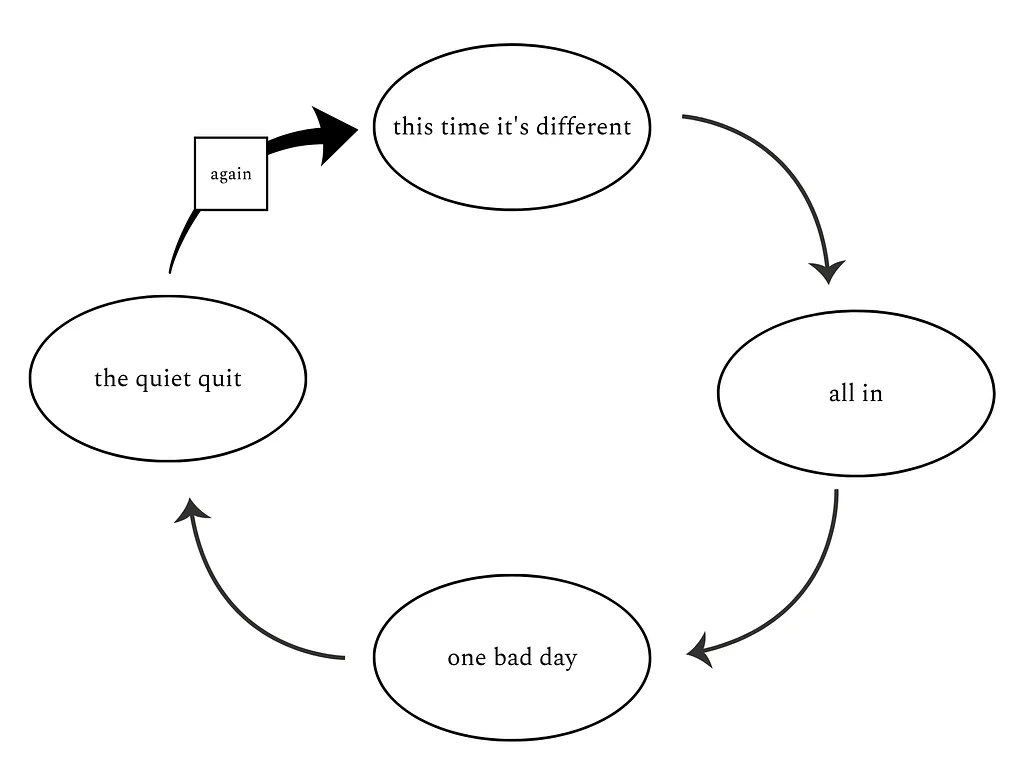
So you made a plan. A real one. This time it's different. And for a week or two, it was. Then a bad day. A miss. And quietly, without ever deciding to, you stopped.
Some time later, the weight builds again — and the next plan gets written. Bigger this time.
You've been here before. Probably more than once. And the hard part isn't that it happened — it's that it keeps happening, the same way, and you don't know why. You meant it every time. So what keeps breaking?
There's an answer. I know this loop from the inside — I was in it for years. And it's not that you're lazy or broken. It's something in how the attempt itself is built — something you can actually fix once you see it.
Your promise and your follow-through came apart
Here's the thing that's actually breaking.
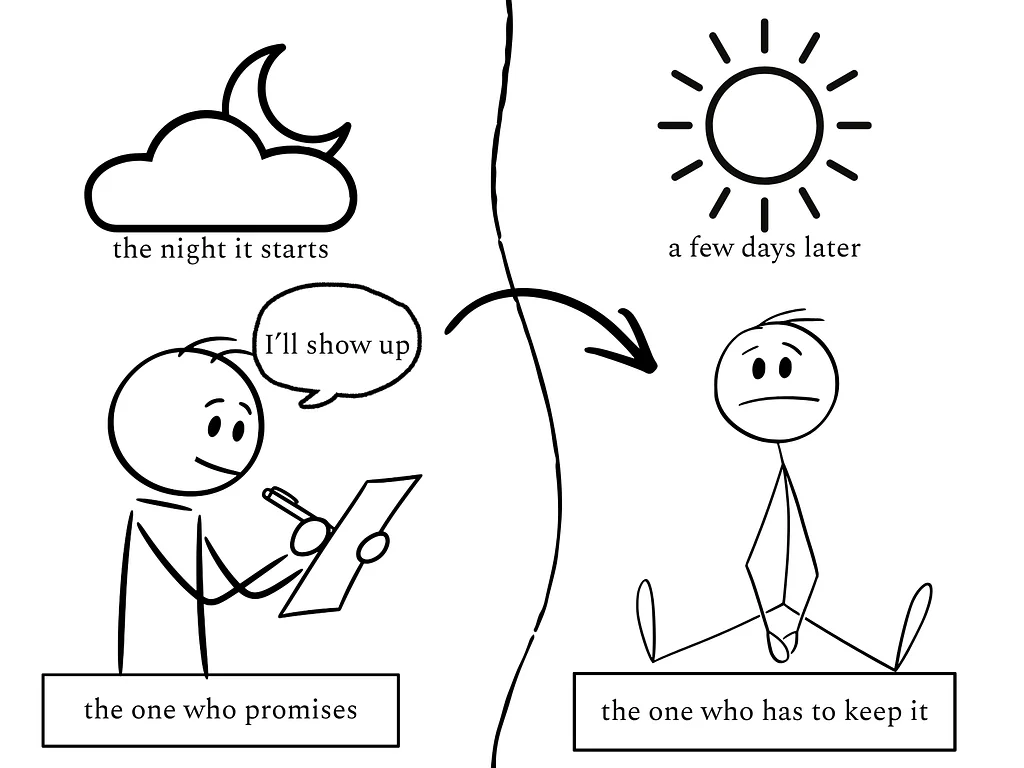
There's the part of you that makes the promise — that decides, plans, commits. And there's the part of you that has to carry it out later, when the moment comes. Most of the time those two are separated by hours or days, and by the time the second one shows up, whatever the first one was feeling is long gone.
When you keep your word to yourself, those two are working together. The one who promised and the one who acts are on the same page. When you don't, they've come apart — a promise made and not kept. Not because you didn't mean it. You meant it every time.
That gap has a name you already use for it: I can't trust myself.
And that's not a mood or a confidence problem. It's literal. Trust is just knowing that what someone says and what they do will match. You've watched your own promises not match your own actions enough times that you stopped believing them — the same way you'd stop believing anyone whose words kept not coming true.
The blame has been on the wrong one
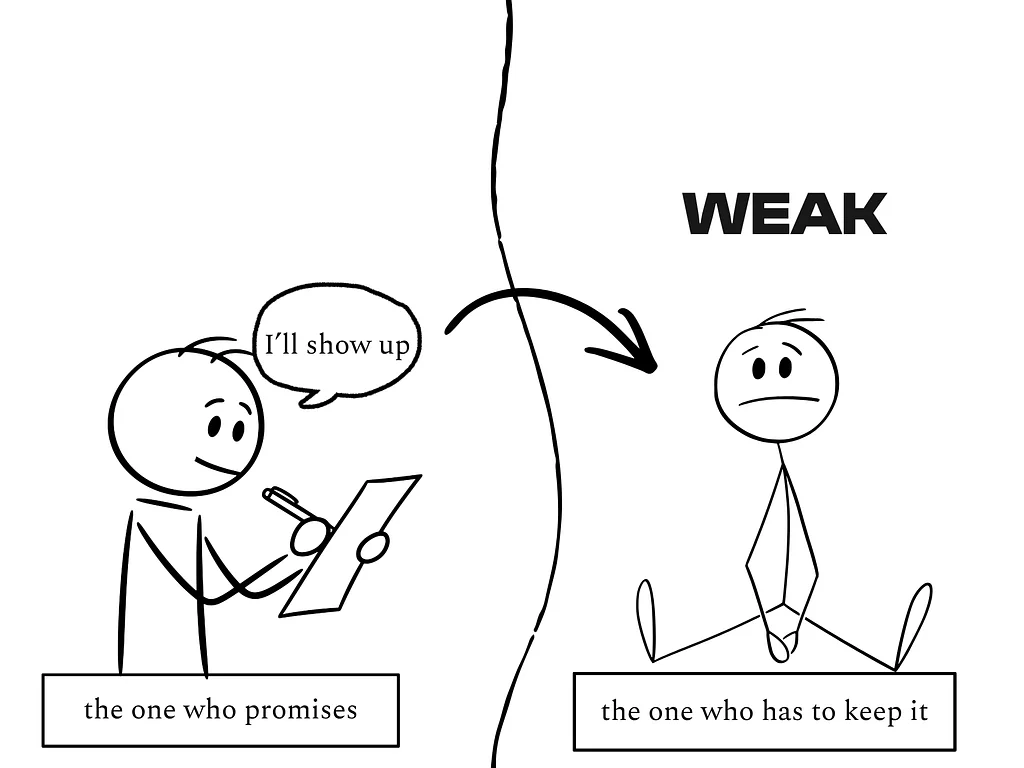
So if the promise keeps breaking, one of those two is doing something wrong. And you've already decided which.
Every time it fell apart, you blamed the same one — the part that didn't get up, skipped the workout, ate the thing. The doer. Every collapse filed under one word: weak.
But nobody ever looks at the one who made the promise.
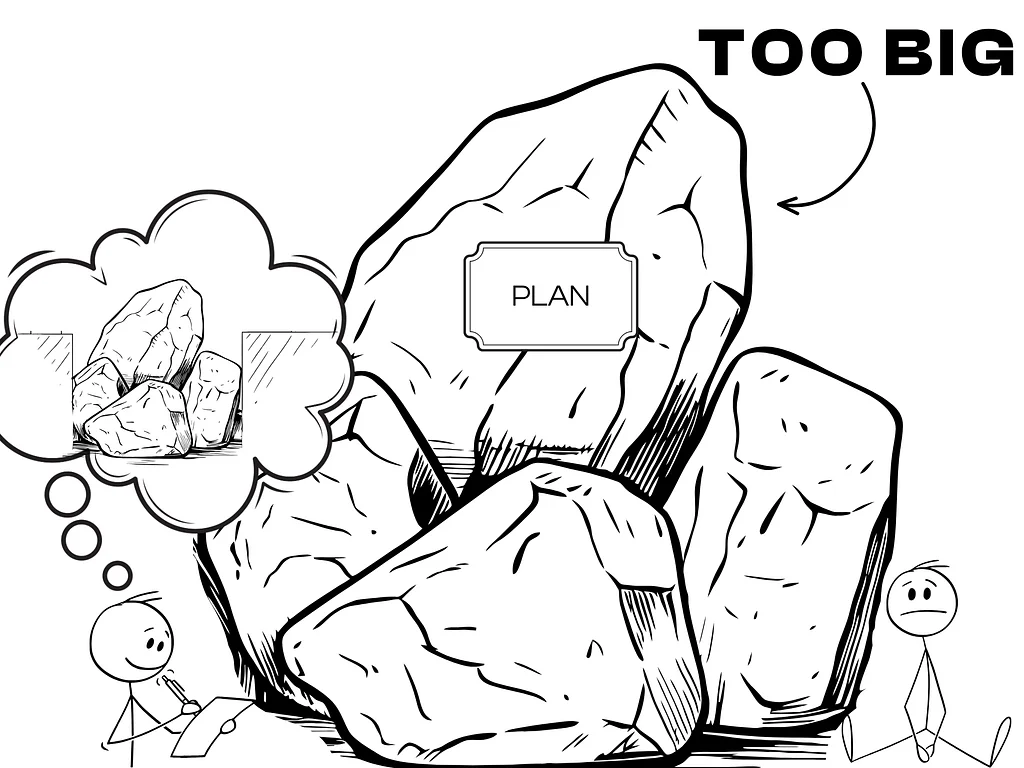
Look at what that part handed over. Fix the diet, the training, the sleep, the scrolling — all of it, at once, starting Monday. A promise so big that one ordinary bad day could bring the whole thing down. The doer never had a chance. Not because it was weak — because it was handed something impossible.
It's the same as a manager who gives an employee a week's work and one afternoon to finish it, then calls the employee useless when it isn't done. The employee isn't the problem. The handoff is.
You meant it every time. That was never the problem. The problem was the size of what kept getting promised.
Why the promise comes out too big
Which raises the real question: if oversized promises keep breaking you, why do you keep making them?
It's not carelessness. There's a reason, and it's close to the center of this whole thing.
You usually start trying to change at your lowest point — when the gap between where you are and where you want to be feels enormous. And when that gap is staring at you, it seems obvious that the fix has to match it. A huge gap needs a huge plan. Anything smaller feels like a joke — like you're not taking your own life seriously.
So you let the gap decide the size of the promise.
That's the error. The promise has one job: to be kept. So it has to be sized to what the doer can actually carry tomorrow morning — not to how far you have to go. Sized to the gap, it's guaranteed to break. Which means you break your word again. Which teaches you, one more time, that your word means nothing.
The gap is real. It's just the wrong thing to measure with when you decide what to promise.
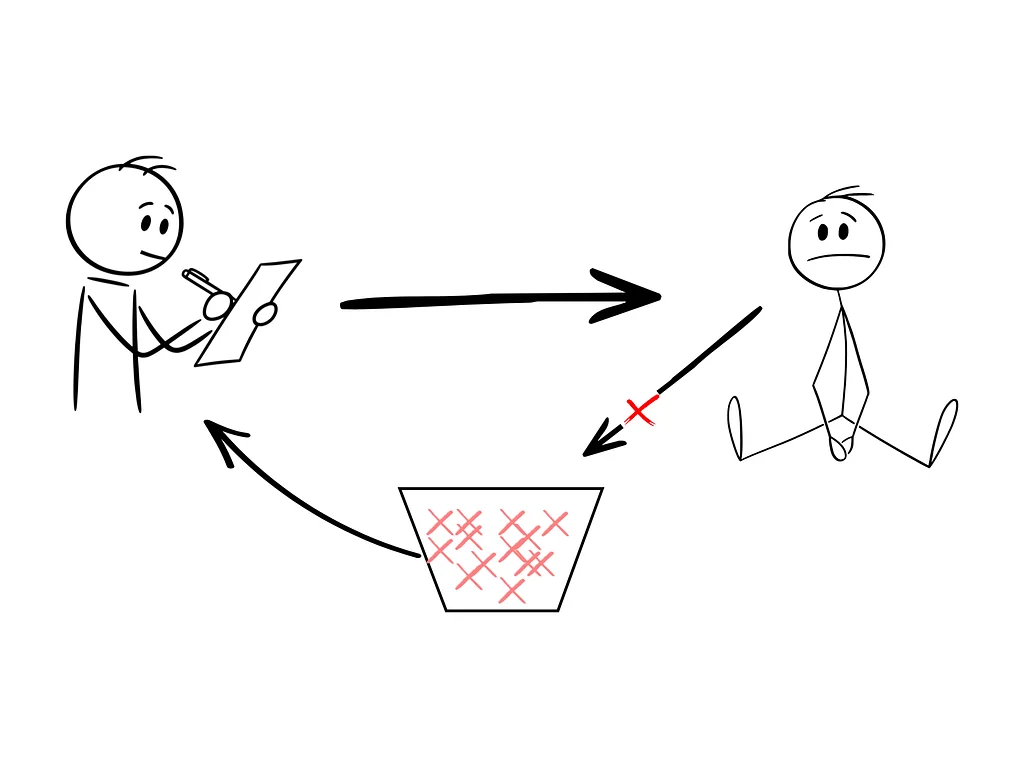
Every break taught your mind the same thing
And those breaks don't just disappear. They add up into something.
Your mind is always trying to predict what you'll do next, and it makes its predictions from what you've done before. So it keeps a kind of record. Every promise you made and didn't keep went into it. You forgot most of them. Some part of you didn't.
After enough entries, it settles on a quiet verdict: when I say I'll do something, I do it — if I feel like it.
That verdict is the stuck feeling. It's why a new plan feels thin even while you're making it — part of you has already checked the record, and the record isn't on your side. Not laziness. Just a mind doing honest math on the only numbers it was given.
But a record only holds what's happened so far. Give it something different to write down, and it has to write that down too.

The fix is one promise the right size
So the way out isn't a bigger promise. You've run that experiment for years. It's the opposite.
You make one promise small enough that the doer will actually keep it — sized to what tomorrow-morning you can carry, not to the size of the gap. And then you keep it. And then you keep it again.
That's the whole move. Not because small is all you're capable of — because a kept promise is the only kind that does anything. A kept promise is your word and your action matching. The two parts of you back on the same side.
And that alignment is the thing you've been missing. It has a few names depending on where you stand. From the outside it's discipline — you do the thing whether you feel like it or not. From the inside it's self-trust — you have evidence now that your word holds. And as the evidence stacks, it becomes something you can say and mean: I'm someone who shows up whether I feel like it or not.
Same thing, three angles. Built one kept promise at a time.
Showing up when you don't feel like it rewrites the record
Here's why keeping that small promise does so much more than its size suggests.
Every time you show up when you don't feel like it, something specific happens. Part of you expected you to fold — that's what the record predicted. And you didn't. That mismatch between what your mind predicted and what you actually did is exactly what forces the record to update. One mark on the other side of the column.
Once is nothing. But stack them, and the rule you've been running on — if I don't feel like it, I don't — gets quietly rewritten into a new one: if I said I would, I do — feeling or not.
You don't argue your way there. You can't think yourself trustworthy, and no one talks themselves into it either. You show up, the evidence stacks, the belief follows the evidence. That's the order it actually works in.
What this is really about
Before we get to the Challenge, one more thing — because it's the part that actually matters.
Your path to anything you want is long. And the whole way along it, discomfort shows up — the bad morning, the low motivation, the day it would be easier not to. If discomfort is allowed to push you off the path every time it appears, you never reach the end of it. Not because the path was too long. Because you kept getting knocked off it, and each time you had to start the distance over.
That's what running on feelings actually costs you. Feel like it, you move forward. Don't feel like it, you stop — or worse, slide back. And you don't get to choose the feeling. It arrives on its own, from how you slept, what someone said, what the screen just showed you. In the moment of action, it's weather.
So if feeling decides whether you keep going, your progress isn't yours. It belongs to whatever mood the day handed you.
You're not choosing your days. They're being chosen for you.
The Challenge is the machine that runs this
That's all The Show Up Challenge is. A way to run this on purpose, every day, for 90 days.
The promise is movement, and it's kept deliberately small — small enough that a bad day anywhere else in your life can't knock it over. The night before, you lay out your workout clothes. That's the promise — your word, given. The next morning, you put them on and move. That's the promise kept — your action, matching your word. You log it, and the day is won.
Ninety days is ninety of those. Ninety times your word and your action meet. Showing up is always the win — and the days you show up when you don't feel like it count double. Those are the days your mind expected you to quit and you didn't. That's the gap that rewrites the record fastest. It starts filling on the other side.
You're not chasing a result here. Your body will likely change — but that's a side effect. What you're building is the thing underneath everything you'll ever want to do on your own terms: a self that does what it says.
Make it easy
If you want a home base that makes finishing easier — your program and your tracking in one place — that's The Show Up System. The Challenge is complete without it.