Why It Works
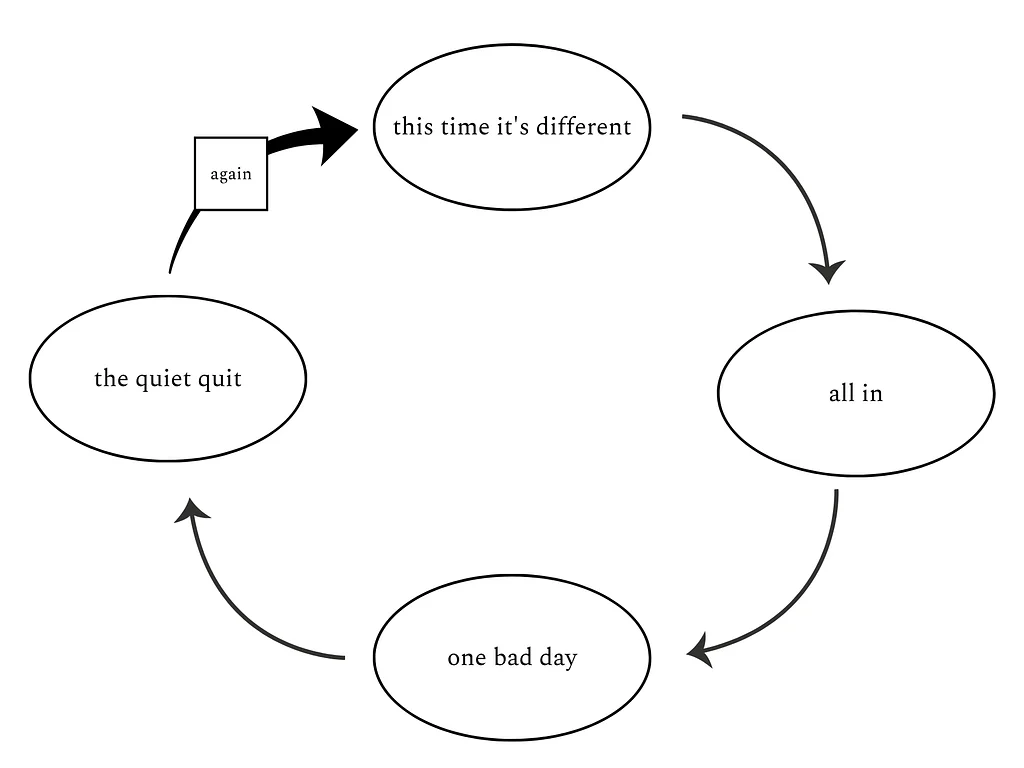
The loop you're stuck in
The pressure builds to a point where you can't ignore it anymore — the gap between where you are and where you want to be overwhelms you. You know you have to change if you want your life to change. But you remember every time you tried before and failed, and that makes the pressure worse.
Eventually it turns into a surge of energy, and you think: this is it, I'm done. You pull out a piece of paper and get to work:
DO: in bed by 10, eat clean, exercise, meditate, read. DON'T: scroll, watch YouTube, smoke, eat junk.
It feels good — you finally took control. This time it's different, you tell yourself, and you mean it. You go to bed ready to prove it.
Day one goes great. Day two you're holding on. A few days in you're tired, your emotions are everywhere, a headache is coming on — and you reach for the one thing you promised you wouldn't. It helps, for a moment. Then the guilt. I already broke it — might as well. One might as well becomes another, and without ever deciding to, you stop.
You carry on a little more defeated than before, until the pressure builds again, and the whole thing repeats. Loop enough times and you end up somewhere strange: spending maximum effort just to tread water.
So what keeps breaking? Why can't you just stay consistent?
This was my reality for years until I found what was behind it – when I saw it, I broke free.
It starts before you think it does
In the moment of relapse, the cause seems obvious: you couldn't resist the temptation, couldn't sit with the discomfort. A willpower problem.
But it isn't. The attempt was set to fail at the very beginning — the moment you made the plan.
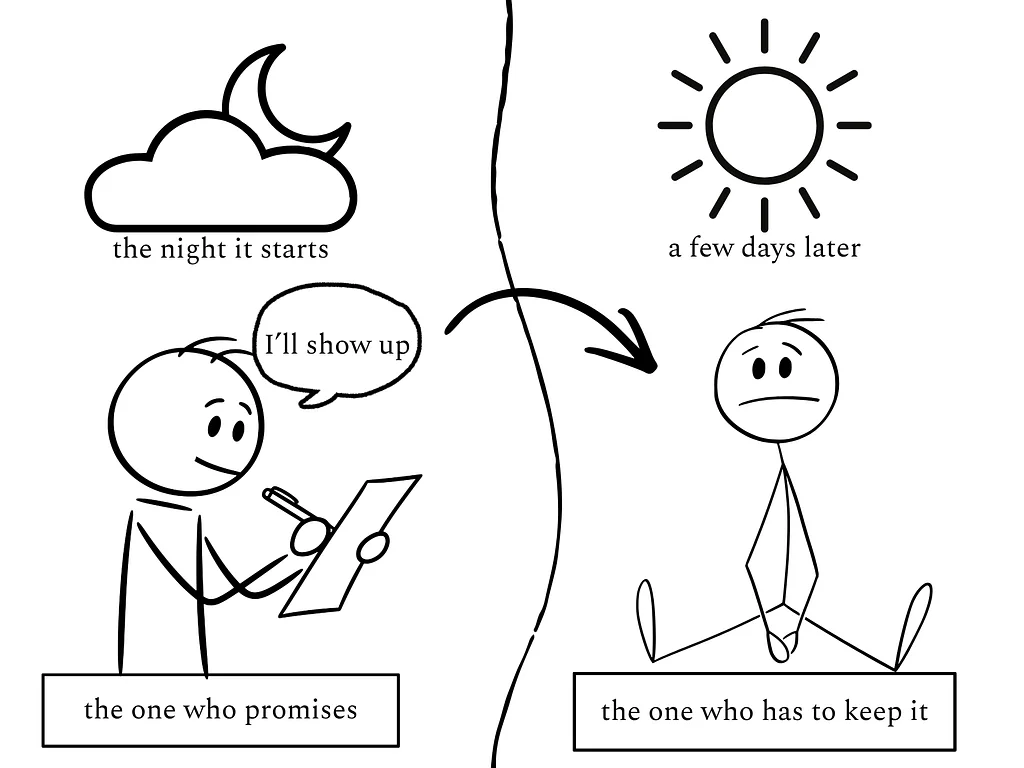
Look at the plan as a promise that you are making to yourself. It involves two versions of yourself, split in time.
There's the one who makes the promise. Motivated, clear, fed up enough to finally act — sitting there at night writing the list, meaning every word.
And there's the one who has to keep it. The you a few mornings later, when the alarm goes at 6, the headache's back, the motivation's gone, and the list says run.
Those are two different people in two different states. The promise gets made by the first and handed to the second. And it breaks in the gap between them — which leaves you with a feeling you already have a name for: I can't trust myself.
The blame has been on the wrong one
If we look closer at what happens at the moment of failure, it looks like this:
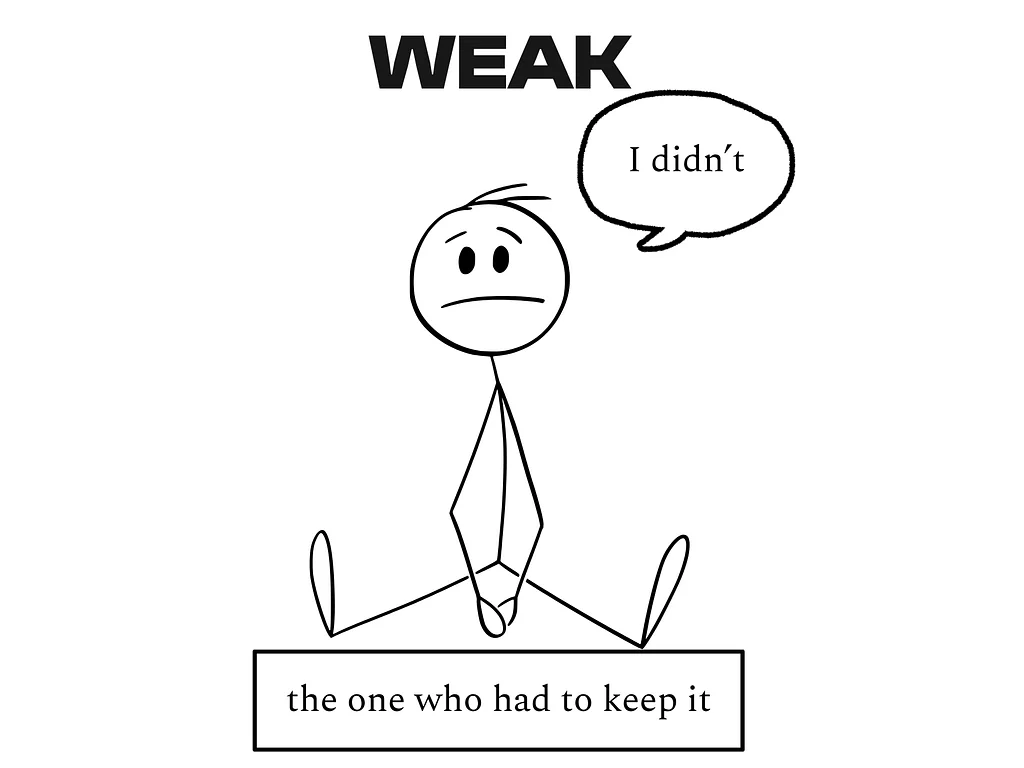
A few days in, you eat the bagel instead of going for the run. It gives you the hit your brain was missing — and right after, the guilt. The two together produce a familiar thought: I failed anyway, might as well have another. That becomes I already slipped, might as well skip the workout too. One might as well after another, and you're back in the old pattern without noticing it happen.
And you get angry at yourself: why am I so undisciplined? Do I have no willpower at all?
That's the blame landing where the failure showed up in time — on the part of you that had to act. It's the obvious suspect, because it's closest to the moment things fell apart.
But the failure didn't happen on day three. It happened on day zero — when the plan was made.
The plan was sized to the gap, not to you
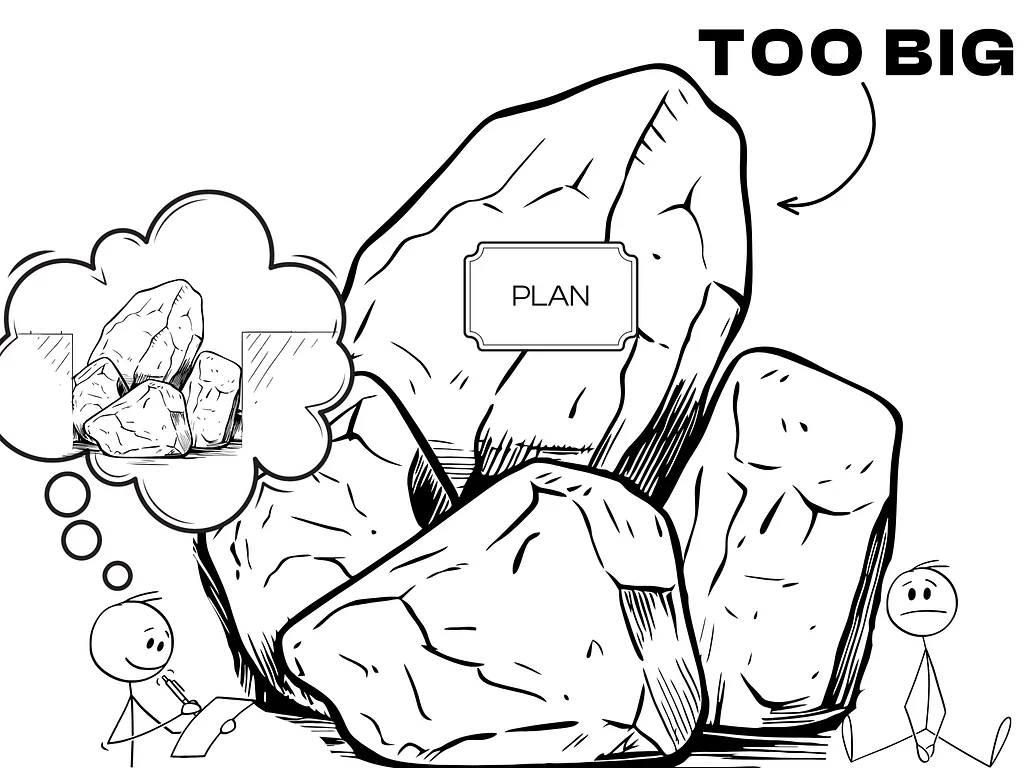
The one who made the plan was running on motivation — powered by the pain of seeing the whole distance between where you are and where you want to be. In that state, the plan felt good. It felt like finally taking control. You meant all of it.
But motivation is a feeling, and feelings pass. A few days later it's gone — and the plan still has to be carried out, by a version of you who never had the motivation it was written in.
It's like a manager who hands an employee a week of work and one afternoon to do it, then calls them useless when it isn't done. The employee was never the problem. The task was sized to the manager's ambition — not to what the employee could actually carry.
That's what keeps happening inside you. The plan gets sized to the gap — the whole distance you want to cross — instead of to what the acting part of you can actually carry on an ordinary Tuesday morning, with no motivation, a headache, and a bad night's sleep behind it.
It was never built to be kept. So it wasn't.
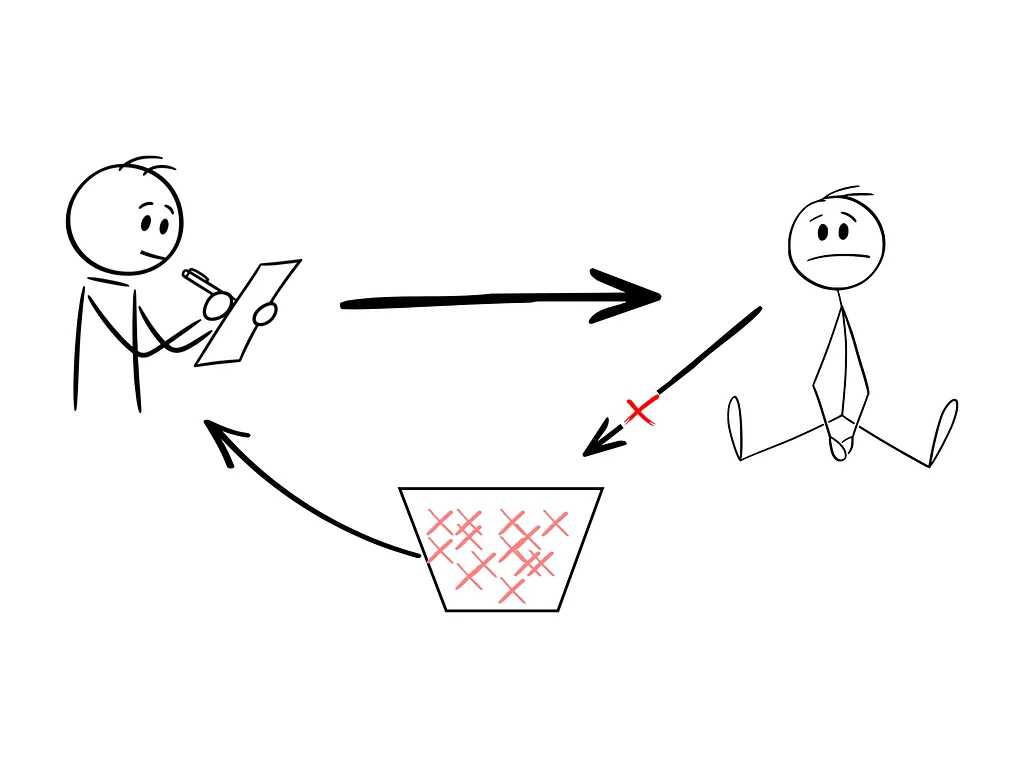
Every broken promise gets stored
All of the small broken promises that eventually led to the plan falling apart might be forgotten quickly by you – but your brain doesn't forget them.
Your brain is a prediction machine. It watches what you do, builds a model of who you are from the evidence, and uses that model to predict what you'll do next. Every promise you made and didn't keep went into the evidence base that your brain uses to confirm its model: I don't follow through.
Over time the you feel fundamentally stuck, unable to follow through on anything – it looks like a discipline problem, but it is really a self-trust problem: the version of yourself that makes the plan lacks confidence that the version of yourself that has to keep it will do it. The version of yourself that has to keep it has so far been unaware that the problem was not them, but the plan itself. This created the reinforcing negative feedback loop that has been keeping you stuck for so long.
Since these two are actually you, they are totally connected on every level. So when the problem is solved in the right place, this negative reinforcing feedback loop turns positive. So instead of self-trust, discipline, confidence, integrity, etc. going down perpetually – they start going up perpetually.
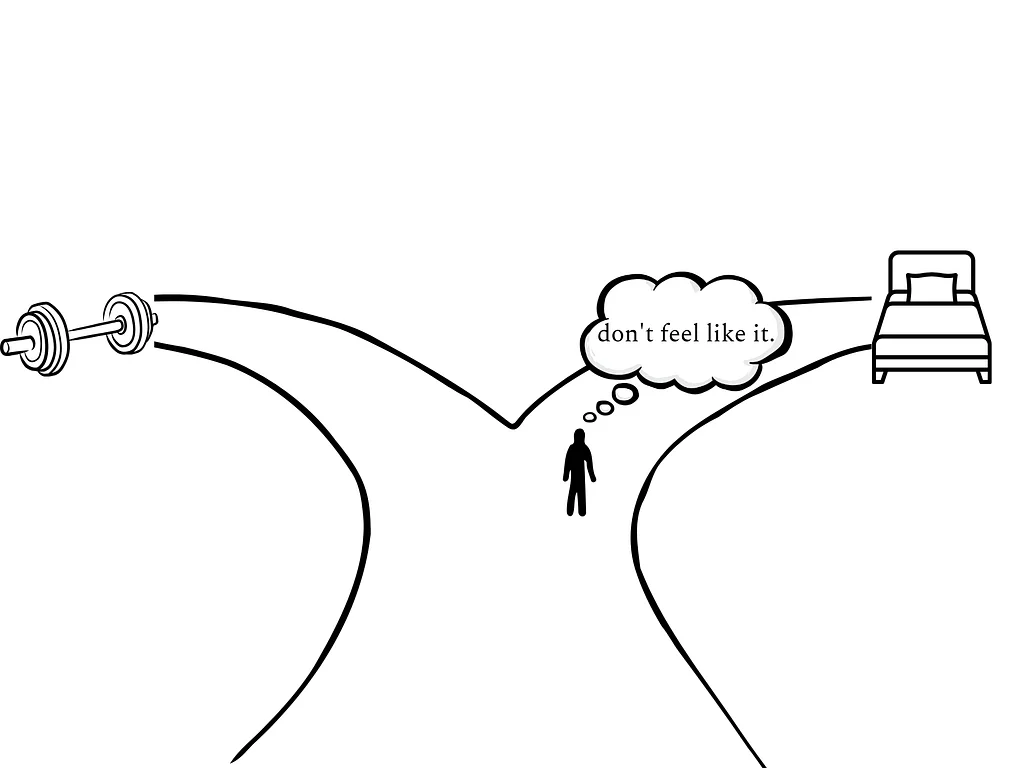
Which means your feelings are running your life
Read that prediction again: I do it — if I feel like it.
That's not just a forecast. It's a description of who's in charge.
If your word doesn't decide what you do, your feeling does. Feel like it, you act. Don't feel like it, you don't.
And your feelings aren't yours to choose. They show up on their own — from how you slept, what someone said, what the screen just showed you. They're weather.
So you're not choosing your days. They're being chosen for you. And a life where your feelings pick your direction is a life you can't steer — which is the exact opposite of what you need if you ever want to walk a path you chose.

The fix is changing how the attempt starts
So how do you turn it around? How do you start trusting yourself again, so you can start choosing the direction of your life?
You change the starting conditions of the attempt.
There's an idea in chaos theory called sensitive dependence on initial conditions — the butterfly effect. A small change in how something starts can completely change where it ends up. Well begun is half done.
You've seen where the old attempts actually failed: at the very start, in the design — a plan sized to the gap, handed to the part of you that has to act without the motivation it was written in. So the fix isn't a bigger promise. It's the opposite: one promise, sized to what the acting part of you can actually keep. Kept. Then kept again.
Kept promises rewrite the program
Here's what keeping it does.
Some days you'll feel bad and you won't want to go — and on most of those days, you'll go anyway. Every time that happens, you create a prediction error. Your mind predicted you wouldn't. You did.
When enough prediction errors happen over a long enough time, they stop being errors. They become the new prediction. That's the transformation — not a leap into a new life, a rewrite of one line:
The old program: if resistance is high and motivation is low → don't act.
The new program: if resistance is high and motivation is low → act anyway.
The Challenge is 90 days of running that rewrite
The Show Up Challenge is built to run this on purpose, every day, for 90 days.
Every evening you put out your workout clothes — that's your word, given. Every morning you put them on and show up — that's your word, kept. One promise per day, to keep or not.
Make no mistake: showing up for exercise every day is not easy. The Challenge is structured to make it hard but possible.
The goal isn't your dream body in 90 days. It's to be able to say, without a hint of doubt in your body: I'm someone who shows up whether I feel like it or not. That goal changes what counts as a win — the quality of the workout doesn't matter. You got up, put on the clothes, and showed up. That's the win. And you'll notice showing up usually leads to finishing the workout anyway — well begun is half done, at the scale of a single morning.
The clothes are the other half of the design. They're laid out before the moment of resistance ever arrives, so the morning has less to negotiate — and they make the two parts of you visible in real life. The clothes are your word. Putting them on is keeping it.
And it's the only non-negotiable. You don't also commit to fixing your eating, your sleeping, your smoking, your scrolling. Which means you can eat a pizza and still show up the next morning — the pizza has nothing to do with the promise you made.
What comes out the other side
After 90 days, discipline isn't something you use. It's part of the program you run on.
And things you thought were separate turn out to be connected. Discipline, integrity, confidence, courage, self-trust — they emerge from the same place: your word and your action getting aligned. And further down that same line: meaning, freedom, and a life you chose.
No one can help you find your path. Only you can find it. But finding it requires one thing — that you're the one steering your actions.
It's free, and it's complete on its own. You put out your clothes tonight. You start tomorrow.
Make it easy
If you want a home base that makes finishing easier — your program and your tracking in one place — that's The Show Up System. The Challenge is complete without it.